What Voltage Should You Use for Hairstrokes, Powder Brows, Eyeliner, and Lip Blush?
- Share
- publisher
- Charming Tattoo
- Issue Time
- Jun 5,2026
Summary
Discover the best PMU voltage settings for hairstrokes, powder brows, eyeliner, lip blush, and areola procedures. This guide covers recommended voltage ranges, stroke lengths, skin considerations, and machine setup tips to improve pigment retention, precision, and overall PMU results.
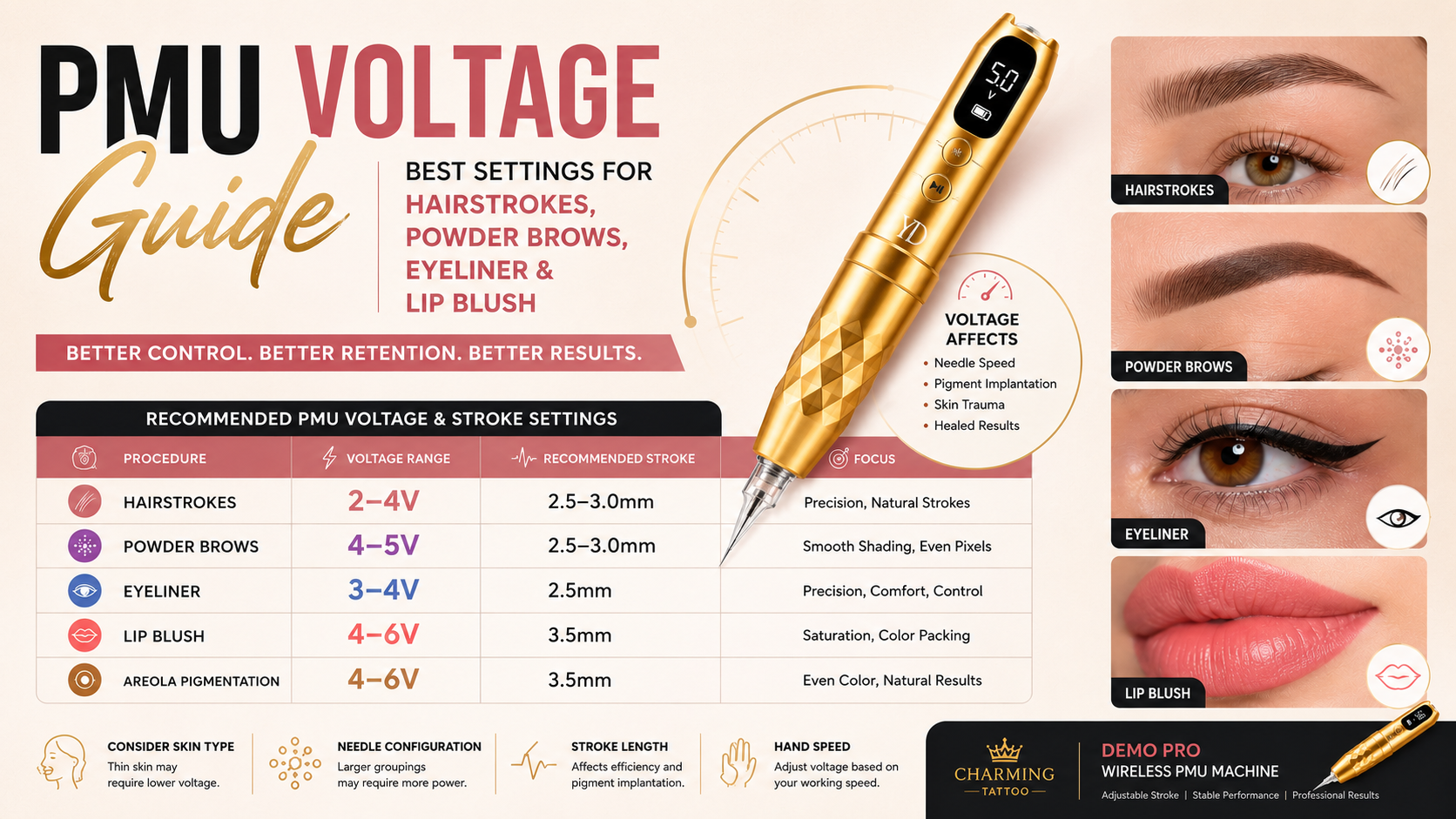
One of the most common questions PMU artists ask is: what voltage should I use? The answer depends on several factors—the specific procedure, skin type, needle configuration, machine stroke length, and your working speed. This guide provides clear voltage recommendations for each major PMU procedure so you can achieve optimal results every time.
Voltage settings are starting points, not rigid rules. Always test on practice skin and adjust based on your specific equipment and technique.
Quick Answer: Recommended PMU Voltage Settings
| Procedure | Recommended Voltage |
|---|---|
| Hairstrokes | 2 – 4V |
| Powder Brows | 4 – 5V |
| Eyeliner | 3 – 4V |
| Lip Blush | 4 – 6V |
| Areola Pigmentation | 4 – 6V |
Why Voltage Matters
Voltage directly controls the speed at which the needle moves. Understanding this relationship is the foundation of good PMU technique:
- Lower voltage = slower needle speed, giving you more control for fine detail work like hairstrokes and fine lines
- Higher voltage = faster needle speed, ideal for shading, color packing, and covering larger areas efficiently
Using the wrong voltage can lead to poor pigment retention, unnecessary skin trauma, blurred lines, or uneven color distribution. Matching voltage to the procedure helps ensure consistent, professional results.
Best Voltage for Hairstrokes
Recommended: 2 – 4V
Hairstrokes require precision and control. A lower voltage range of 2 to 4V allows you to create fine, crisp incisions that mimic natural hair growth. This setting is ideal for:
- Nano Brows
- Machine Hairstrokes
- Hyperrealistic brows
For hairstroke work, a machine stroke length of 2.5–3.0mm is recommended to complement the lower voltage settings and maintain precise needle depth control.
Best Voltage for Powder Brows
Recommended: 4 – 5V
Powder brows need a slightly higher voltage to achieve smooth, even pixel shading. The 4 to 5V range provides enough needle speed for consistent pigment distribution while maintaining control over the saturation level. This range works well for:
- Ombre brows
- Powder effect brows
- Combination brows
Starting at 4V and increasing as needed gives you the flexibility to build density gradually.
Best Voltage for Eyeliner
Recommended: 3 – 4V
Eyeliner work demands a careful balance between precision and pigment saturation. The 3 to 4V range is the sweet spot for creating:
- Tight, defined lash lines
- Classic eyeliner
- Lash line enhancement
Working at this voltage helps prevent pigment blowout while ensuring adequate color deposit in the delicate eye area.
Best Voltage for Lip Blush
Recommended: 4 – 6V
Lip tissue is different from skin—it requires higher saturation for lasting color. The 4 to 6V range provides the needle speed needed to deposit pigment effectively. This range supports:
- Full lip color
- Lip blush enhancement
- Lip correction and symmetry
Start at 4V for the outline and increase to 5–6V for filling, adjusting based on pigment density and client lip condition.
Best Voltage for Areola Pigmentation
Recommended: 4 – 6V
Areola pigmentation shares similar voltage requirements with lip work due to the need for thorough color coverage. The 4 to 6V range allows for careful density management while achieving full saturation. Key considerations for areola work include:
- Use lower end of range for outline and definition
- Increase voltage gradually for filling larger areas
- Monitor tissue response closely to avoid overworking
Factors Affecting Voltage Choice
Your optimal voltage may vary based on these key factors:
- Skin Type: Oily skin may require slightly higher voltage for adequate pigment retention
- Needle Configuration: Magnum needles perform well at lower voltages; single needles may need higher settings
- Machine Stroke Length: Longer stroke machines can achieve similar results at lower voltages
- Artist Speed: Faster hand speed may need higher voltage to compensate
- Pigment Consistency: Thicker pigments may require increased voltage for smooth flow
Conclusion
There is no single universal voltage that works for every PMU procedure. Use this guide as a starting point, and adjust based on your equipment, technique, and the specific needs of each client. With practice and careful observation, you will develop an intuitive feel for the right voltage in every situation.
Frequently Asked Questions
What voltage should I start with for hairstrokes?
Start at 2–3V for hairstrokes. This lower range gives you maximum control for creating fine, precise incisions. You can increase to 4V if needed, but always begin low and adjust upward.
Can I use the same voltage for all PMU procedures?
No. Each procedure has different voltage requirements based on the tissue type and desired outcome. Hairstrokes need lower voltage (2–4V), while lip blush and areola pigmentation need higher voltage (4–6V). Adjust your settings for each procedure.
What happens if I use too high voltage for eyeliner?
Using excessively high voltage for eyeliner can cause pigment blowout, where the pigment spreads beyond the intended line. It may also increase tissue trauma, leading to prolonged healing and inconsistent results.
Does skin type affect voltage choice?
Yes. Oily skin typically requires slightly higher voltage for adequate pigment retention, while dry or thin skin may need lower settings to avoid overworking. Always assess the client’s skin before selecting your voltage.
What is the best stroke length for PMU machines?
For most PMU procedures, a stroke length of 2.5–3.0mm works well. Shorter strokes (1.5–2.5mm) are preferred for fine detail work like hairstrokes, while longer strokes (3.0–4.0mm) can aid color packing for lip blush and areola pigmentation.
How do I know if my voltage is too high or too low?
If voltage is too high, you may see excessive tissue trauma, bleeding, pigment blowout, or uneven color. If too low, the needle may struggle to deposit pigment, resulting in faint or inconsistent strokes, prolonged procedure time, and poor color retention. Your machine should run smoothly without excessive vibration or resistance.
Need More Help?
- Why Choosing the Right PMU Eyebrow Pigment Matters More Than Technique in 2026
- Professional SMP Pigment System: How to Prevent Blue Shift and Achieve Natural Healed Results
- What We Learned from the WORLDS PMU Championship in Miami 2026
- What Certifications Should a Professional PMU Pigment Manufacturer Have